

State Flag of West Virginia

December 29, 2011

The current version of the West Virginia was adopted on March 7, 1929. The flag is rectangular with a white background and dark blue border. The West Virginia coat of arms appears in the center of the flag. Rhododendrons, West Virginia’s state flower, decorate the coat of arms. The text “The State of West Virginia,” appears on a red ribbon above the coat of arms. The text “Montani Semper Liberi,” (“Mountaineers are Always Free”) appears on another red ribbon below the state seal.

The coat of arms bears symbolic meaning for the people of West Virginia. The two men depicted in the coat of arms symbolize West Virginia’s agriculture and industry. The man on the left side of the coat of arms is a farmer, holding an ax and plow and standing in front of a cornstalk. On the right side of the coat of arms is a miner holding a pickax. An anvil and sledge hammer appear on behind the miner, representing mining’s importance to West Virginia’s industrial growth.

In between the two men is a boulder inscribed with the date June 20, 1863, the day West Virginia became an official state of the Union. On the grass in front of the boulder are two rifles and a Phrygian, or liberty, cap, representing the importance of the West Virginia people’s conquest for liberty.

Although the current West Virginia flag was adopted in 1929, the West Virginia State Legislature adopted the state’s first flag in 1905. The original flag had a white background with a blue border, but a larger rhododendron appeared on the front of the flag and the West Virginia coat of arms appeared on the back. Two years later, in 1907, another version of the flag reversed the images: the rhododendron appeared on the back and the coat of arms on the front. Unfortunately, manufacturing a flag with different front and reverse sides was expensive, and by 1929, the state adopted a flag with the rhododendron and coat of arms depicted together on the same side.


Flag of Delaware

October 31, 2011

The flag of the state of Delaware was adopted on July 24, 1913. The flag is rectangular with a colonial blue background. The center of the flag features a buff-colored diamond and the Delaware coat of arms appears inside the diamond. The date December 7, 1787 appears on the bottom of the flag below the coat of arms. This date refers to the day on which the state of Delaware was the first state to ratify the United States constitution. This bold action made Delaware the first official state in the Union, and because of this, Delaware holds first position at national events like presidential inaugurations.

The other elements of Delaware’s state flag have important meaning for the state and recall the Revolutionary era. The blue and buff colors on the state flag of Delaware, for example, symbolize the colors of George Washington’s uniform.

The elements of the coat of arms also represent important people and industries of the state of Delaware during the Revolutionary era. The center of the coat of arms features a shield with horizontal red, blue, and white stripes. An ear of corn and sheaf of wheat appear in the red stripe, symbolizing the importance of agriculture in Delaware’s economy. The blue stripe is plain, representing the Delaware River, and the river’s importance to Delaware’s transportation and economy. An ox appears in the white stripe and reflects the importance of animals in Delaware’s economy. A ship appears above the shield, symbolizing the importance of shipbuilding and trade to Delaware’s economic livelihood.

Two men appear on either side of the coat of arms: a farmer with a hoe and a militiaman with a musket. These two men reinforce the importance of farming in Delaware and also emphasize the importance of the militia—an army made up of civilians—in gaining independence during the Revolution. Under the shield and the men are the words “Liberty and Independence,” Delaware’s state motto.


State Flag of Indiana

October 6, 2011

The flag of the state of Indiana was adopted on May 31, 1917. The flag is rectangular with a blue background and features a gold torch. Thirteen gold stars surround the flag in a circular shape and five gold stars make up an inner semicircle. Just above the torch is one more star and the word, “INDIANA,” in gold lettering.

The symbolism of the Indiana state flag is relatively simple, although very meaningful. The torch symbolizes liberty and enlightenment, and the six rays around the torch’s flame represent the broadness and expansiveness of these values. As with other state flags that include thirteen stars, the thirteen gold stars that encircle the torch represent the thirteen original colonies of the United States. Indiana was the nineteenth state to enter the Union; and the five stars in the semicircle on the lower half of the flag symbolize the five states that entered the Union before Indiana. The star at the top of the torch, the largest star on the flag, stands for Indiana.

Although Indiana became a member of the United States in 1816, the state did not have a flag until its residents celebrated the Indiana Centennial in 1916. In anticipation of the centennial, the Indiana General Assembly requested that the Daughters of the American Revolution Indiana Chapter sponsor a contest for the state flag’s design.

After more than two hundred submissions were submitted, Paul Hadley, an artist living in Mooresville, Indiana, won the design contest, as well as a cash prize of one hundred dollars. The state flag was officially adopted on May 31, 1917, with the addition of the word “INDIANA” to Hadley’s original design. Since the flag’s adoption in 1917, the flag’s design has remained unchanged with the exception of a 1955 statute that standardized the flag’s dimensions.


State Flag of Maryland

September 19, 2011
The Flag of Maryland

The Flag of Maryland

The flag of the state of Maryland was adopted on November 25, 1904. The Maryland flag is rectangular and divided into four fields. The top left and bottom right fields feature the coat of arms of the Calvert Family and the top right and bottom left feature the coat of arms of the Crossland family.

Maryland is the only state in the United States to use a British coat of arms for its state flag. The two coats of arms represent the banner of George Calvert, 1st Baron Baltimore, who was a British politician, colonizer, and Parliament member in the seventeenth century. Calvert became interested in establishing colonies in Newfoundland, and, after realizing Newfoundland’s weather was unsuitable for English settlers, began drafting a royal charter to colonize what is now the state of Maryland. Although Calvert died several weeks before the charter was sealed, Calvert is historically recognized as the founder of Maryland.

George Calvert’s son, Cecilius Calvert, 2nd Baron Baltimore founded the colony of Maryland. From Maryland’s founding until the Civil War, only the gold and black Calvert coat of arms was used to represent Maryland. During the Civil War, Maryland remained in the Union; however, many of Maryland’s citizens chose to fight with the Confederate Army of Northern Virginia and began using the Crossland coat of arms as their secession banner.

After the Civil War, Maryland’s citizens began flying flags that included both coats of arms, in an effort to reconcile conflicted feelings. The flag of Maryland that is used today was first flown on October 11, 1880 at a parade marking the 150th anniversary of Baltimore’s fouding. It was later used on October 25, 1888 at Gettysburg during a ceremony dedicating monuments to the Maryland regiments that fought for the Army of the Potomac. Maryland’s state flag was officially adopted on November 25, 1904.

The flag of Maryland’s colors and symbols are used prominently throughout the state. The city of Baltimore and the counties of Baltimore, Howard, Calvert, and Worcester all have coats of arms and/or flags that incorporate one or both of the flag of Maryland’s coats of arms. The University of Maryland, Loyola University Maryland, and Johns Hopkins University, the Maryland’s sports teams all use the colors or symbols of the Maryland flag in some way as well.


Flag of Arkansas

August 15, 2011

The flag of the state of Arkansas is a U.S. state flag with a very interesting history and meaning behind it. The current state flag of Arkansas is rectangular with a red background. In the center of the flag is a large white diamond with a blue border. Twenty-five white stars appear inside the blue border. In the center of the white diamond, the word “Arkansas” appears in blue capital letters, with one blue star above and three blue stars below it.

Although the current version of the Arkansas state flag was adopted on March 16, 1924, Willie Kavanaugh Hocker designed Arkansas’s first state flag in 1912. In this year, the Daughters of the American Revolution’s Pine Bluff chapter decided to hold a contest to develop a design for Arkansas’s state flag. Willie Hocker, who was also a member of the Pine Bluff chapter, won the contest.

The original design for the Arkansas state flag is similar to the current version, but in the original version, only three stars appear, all in one line, in the center of the white diamond. The word “Arkansas” was not included in the original design. Arkansas’s Secretary of State Earle Hodges requested that Hocker add the state’s name to the flag, and Hocker complied, rearranging the stars so that one blue star appeared above “Arkansas” and two appeared below the name. The Arkansas state legislature adopted this version of the flag was adopted on February 26, 1913.

In 1923, for only one year, a fourth star was added above the state’s name. These four stars represented the Confederate States of America, and the three countries Arkansas has been part of: Spain, France, and the United States. In 1924, the Arkansas State legislature moved the fourth star below the word Arkansas, and rotated it so that the top point of the star faces downward.

The flag’s images have deep symbolic meaning. The diamond in the center of the flag represents that Arkansas, before recent diamond discovers in America’s Rocky Mountain region, was the only state in the United States that contained known quantities of diamonds. The twenty-five stars inside the diamond’s blue border represent Arkansas’s admission to the Union as the twenty-fifth state.

The four inner stars’ meanings are more complicated. The star above the word “Arkansas” is now said to represent the Confederate States of America. The three stars below Arkansas have three separate representations. First, the three stars represent the three states Arkansas has been a part of: Spain, France, and ultimately the United States. Second, the three stars represent the year 1803, when the Louisiana Purchase made present-day Arkansas part of the United States. Finally, the three stars also recognize that Arkansas was the third state admitted to the Union from the Louisiana Purchase’s territory.


Flag of Ohio

July 29, 2011

The flag of the state of Ohio is one of the most unique state flags of the United States because it is the only state flag in the nation that is not rectangular. John Eisemann designed the flag of the state of Ohio for the Pan-American Exposition, a world’s fair in Buffalo, NY, in 1901. The flag was officially adopted in 1902.

The flag of the state of Ohio is a non-rectangular, swallow-tailed shape. The top and bottom hems of the flag taper inwards towards the flag’s fly end and a triangular portion of the flag is removed from the fly end. Although the only state flag of the U.S. to use this shape, this swallow-tailed element of the flag is common military units.

Like most state flags, the design of the flag of the state of Ohio holds great significance in terms of Ohio’s admittance to the Union, the people of Ohio, and the state’s natural elements. The flag has five large horizontal stripes: the top, bottom, and middle stripes are red and the stripes in between the red stripes are white. This not only bears similarity to the flag of the United States, but also represents Ohio’s roads and rivers.

The large blue triangle with white stars inside that appears on the left side of the flag is another feature of the Ohio flag that reflects the design of the U.S. flag. The blue triangle also symbolizes Ohio’s hills and valleys. The white stars on the Ohio state flag are divided into two groups: there are thirteen stars on the left side of the flag and four, more widely spaced stars on the right. The thirteen stars represent the thirteen original colonies of the United States. The other four stars, when combined with the thirteen, add up to seventeen stars, representing Ohio’s admittance to the Union as the seventeenth state.

Finally, the white circle with the red center in the middle of the blue triangle is truly unique to Ohio. The white circle represents the letter “O” for Ohio. Adding the red center alludes to Ohio’s nickname, the “Buckeye State.” Not only the name of the Ohio State University sports teams, the buckeye refers to the Ohio state tree, which produces nuts that resemble a buckeye.


Flag of the State of Georgia

July 12, 2011

The current flag of Georgia.

The adopted flag of the U.S. state of Georgia is the newest state flag in the United States and has a very interesting story behind its development. Adopted just over eight years ago, on May 8, 2003, the flag is based off of the design of the Confederate States of America’s first national banner.

The current flag of Georgia, like the U.S. flag, is rectangular and includes a blue field in the upper left corner. The blue field includes the state of Georgia’s coat of arms and thirteen white stars. The coat of arms consists of three pillars, which represent the three branches of state and federal government: executive, legislative, and judicial. An American soldier with a drawn sword, dressed in a Revolutionary War uniform, stands between the pillars, symbolizing the state’s courage to defend the constitution.

Two phrases also appear in the blue field. “Wisdom, Justice, and Moderation,” Georgia’s state motto, appear on a banner around the pillars. “In God We Trust,” is written below the seal, but these words are not actually part of the official Georgia seal. The thirteen stars around the seal signify Georgia’s inclusion in the original thirteen U.S. colonies.

The rest of the flag consists of three horizontal stripes: the top and bottom stripes are red and the middle stripe is white.

Controversy over the state of Georgia’s previous flag, which was used from 1956 until 2001, ultimately led to the flag’s repeal and the design of a new flag. The flag adopted in 1956 prominently featured the Southern Cross, a prominent symbol of the Confederate States of America. Although proponents of the flag claimed that the Georgia state flag was designed to commemorate the Civil War Centennial, others took offense. The flag was adopted at the height of the American Civil Rights Movement, and white supremacy groups were using the Confederate flag as a symbol of racial protest.

Although pressure to adopt a new state flag increased throughout the second half of the twentieth century—especially before the 1996 Olympic Games, which were held in Atlanta—the flag was not replaced until 2001. In that year, the state legislature adopted a replacement flag that featured Georgia’s state seal above smaller versions of Georgia’s previous flag. The current flag of Georgia was adopted in 2003.


Texas Gift Ideas

December 21, 2010

Need a gift for your favorite Texan? Look no further than the United States Flag Store’s website for the best Texas gifts at the best prices!

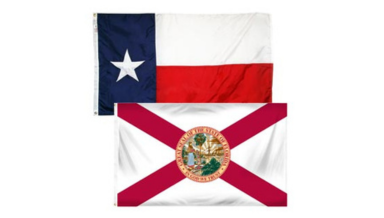
The Six Flags Over Texas gift set is the ultimate Texas flag gift. The gift set includes the six banners that have flown over what is now Texas, including the flags of France, Spain, Mexico, the Confederate States, the United States (28-star version), and, of course, Texas. All flags are 4×6 inches and printed on a polyester-cotton blend. A wooden base is included with the flag set, allowing for display on a desk or table. At a low price of just $7.95 and with a presentation box to boot, this is a great gift for a Texan serving in the military.

The Fibre Metal Texas Hard Hat combines Texas pride with supreme safety. Fibre Metal uses a full graphic process to produce a beautifully vibrant Texas flag that won’t chip, fade, or peel on a SEI-certified thermoplastic hard hat. Besides depicting the Texas flag, the phrase, “Don’t mess with Texas,” appears on the front of the hat.  For business-owners, these hard hats make great safety awards or a special groundbreaking ceremony hats. Order ten or more of these hats to receive an unbelievably low price of $26.99 each!

If you’re just looking for a simple gift, check out the United States Flag Store’s fantastic selection of Texas Stick Flags and Car Flags. The Texas Stick Flags are of the highest quality possible—sewn around the edges for ultimate durability—and are available for as low as $0.80 per flag. The Texas car flag is made of durable, knitted polyester and is double sided to resist wear and tear. At a low price of $7.95 each, order one for yourself and a friend!

For your beach beauty, the United States Flag Store has the ultimate Texas gift: a Texas flag bathing suit! Divided down the center with a blue stripe and white star one side and red and white on the other, this bathing suit is sure to grab the attention of other proud Texans at the pool or beach!


Flag of Virginia

November 29, 2010

The Flag of the Commonwealth of Virginia was adopted on January 31, 1861 at the beginning of the United States Civil War. The flag is rectangular with a blue background. In the center of the flag is the seal of Virginia enclosed in a white circle. Virginia’s seal was designed by George Mason, known as the “Father of the Bill of Rights” and George Wythe, whose signature appears on the United States Declaration of Independence.

The seal depicted on the flag of Virginia features a woman, personifying Virtus, or virtue in ancient Roman times. Virtus is a symbol of peace, and she stands with her sword in its sheath resting her weight on a long spear, indicating a victorious battle. Her bare foot rests on Tyrannis, or tyranny, represented by a man in a purple robe and sandals with a fallen crown. The scene symbolizes the Virginia’s—and the United States’—defeat of the British government during the American Revolution. The broken chain in Tyranny’s left hand further emphasizes Great Britain’s defeat by the American Colonies. Virginia is the only state besides New York to include a crown in its flag.

The word “Virginia” appears on top of the seal, and the Latin phrase, Sic semper tyrannis, appears at the bottom. The motto literally means “Thus Always to Tyrants,” and describes the scene depicted on the seal. The phrase’s origins, like the image, date back to Roman times whe Marcus Junius Brutus assassinated the tyrant Julius Caesar. The phrase has been used to ill effect as well during notable U.S. assassinations. John Wilkes Booth shouted, Sic semper tyrannis, when he assassinated Abraham Lincoln at Ford’s Theatre on April 14, 1865. Timothy McVeigh wore a T-shirt with the phrase and a picture of President Lincoln when he was arrested after the Oklahom City bombing in April 1995. In Virginia, however, saying Sic semper tyrannis, is a common joke dating back to the Civil War and means “get your foot off my neck.”


Flag of South Carolina

November 26, 2010

The Flag of the State of South Carolina was adopted on September 28, 1861. The flag is rectangular with a blue background. In the center of the flag is a white palm tree. A white crescent appears in the upper left corner.

The Flag of South Carolina was first designed for use in the Revolutionary War. In 1775, Colonel William Moultrie developed the state’s first flag, a blue rectangular banner with a white crescent in the upper left corner, the blue color matching the militia uniforms. The word “liberty” appeared inside the white crescent on the first version of the flag.

The original Revolutionary War flag remained in use until 1861, when the South Carolina General Assembly adopted a flag with a palmetto tree in front of a white oval background. The flag was only in use for two days—it is thus known as the “two-day flag”—and two days later the palmetto tree was modified to a simpler white tree in front of the blue background.

The addition of the palmetto tree on the South Carolina flag recognizes Colonel Moultrie and his troops, who defended Charleston by constructing a fort from palmetto logs.  Because palmetto logs are soft, the British cannons were unable to destroy the fort, allowing the Americans to win the battle at Charleston on June 28, 1776.

Like many other Southern States, South Carolina flew a different flag after it seceded from the Union during the civil war era. South Carolina’s Sovereignty/Secession Flag was actually flown in several parts of the Union during the Civil War to demonstrate support for the South. The Sovereignty/Secession Flag features a red background with a blue cross. Inside the blue cross are white stars. In the left corner of the flag, the crescent and the palm tree are featured next to each other.

The meaning of the crescent is debatable. South Carolina soldiers may have worn a crescent on their caps during the revolution. The crescent is also thought to be symbolic of a “second son,” one who came to the United States in search of a more prosperous life.


Follow

Get every new post delivered to your Inbox.